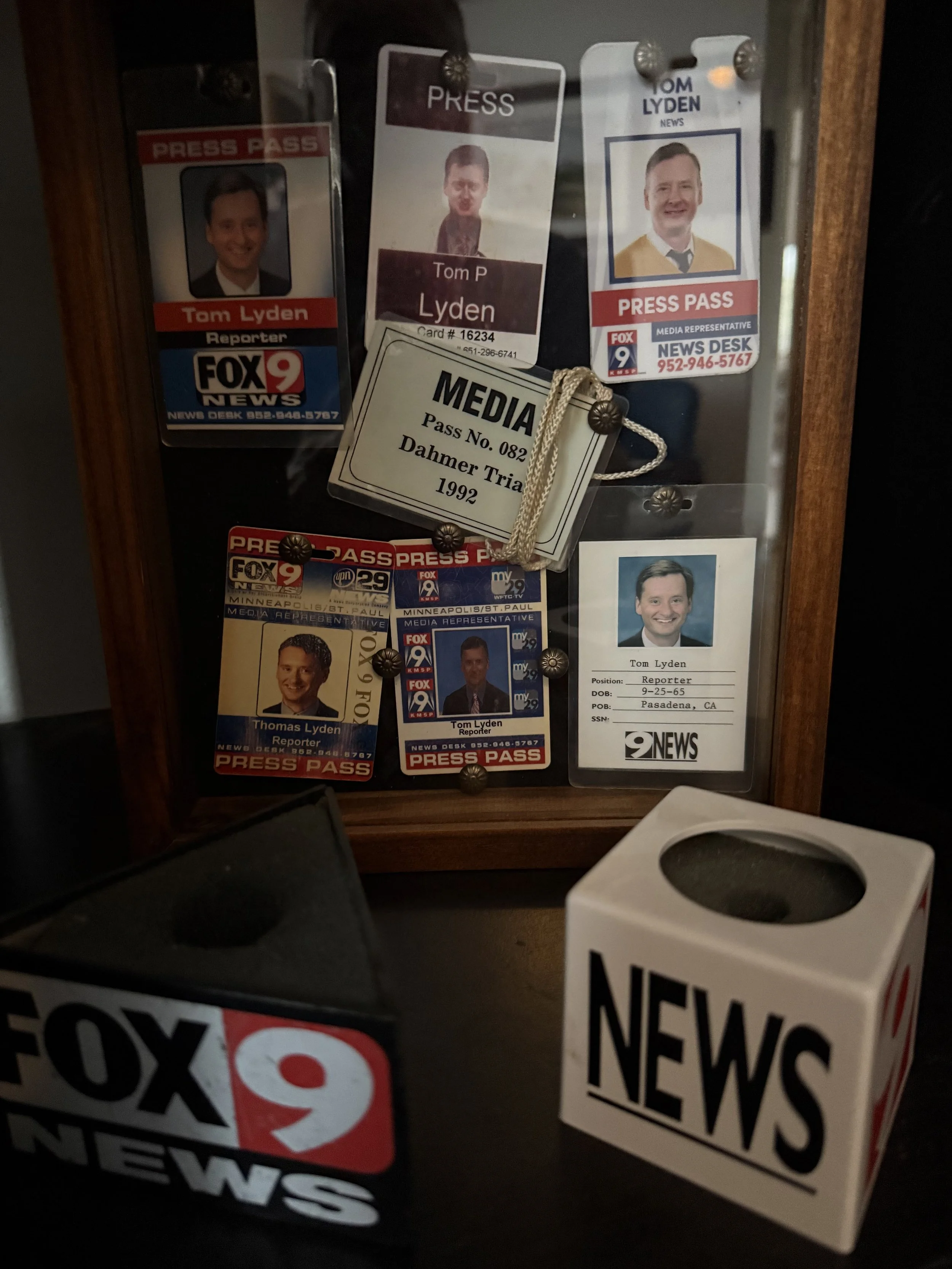
I started my journalism career 38 years ago as a reporter for the Daily Star Progress in LaHabra, California, just as the news business was beginning to see the storm clouds on the horizon.
Back then, it was a wave of newspaper consolidations, with bigger newspapers swallowing up smaller ones like guppies. The Daily Star Progress was bought by the Orange County Register, only to be shut down a few years later.
I could feel the barometric pressure change in the air, and I made a quick pivot to television news. Yes, it might be a more shallow medium, I told myself, but it had promise. Maybe I could make it to 60 Minutes one day.
I moved to the Midwest to get a crash course in broadcast journalism at the University of Missouri-Columbia. I picked Missouri because it was the oldest school of journalism in the country and had a solid reputation.
The motto above an arch leading into the J-School read: “Wise shall be the bearers of light.” On the other side of the arch: “Schoolmaster of the people.”
There is a kind of arrogance to both mottoes. But I was young, and probably a little arrogant and full of myself as well.
The university’s television station was several miles down the highway, below a towering transmitter, surrounded by cow fields. It was there a legendary instructor had his own motto: “Let’s turn chicken shit, into chicken salad.”
That wasn’t a dietary recommendation, but rather an invitation to the craft of television. A craft where good pictures, combined with solid editing and engaging copy, can elevate the most mundane of stories, making someone actually feel a story in their very soul.
The best television has an immediacy and emotional quality that newspapers can’t touch. When done right, television news can take someone to a scene, however remote and different from their daily lives, and make them feel a common humanity, differences melt away.
I was hooked.
I ended up at a television station in Minneapolis-St. Paul that gave me enormous opportunities. I covered Hurricane Katrina, the aftermath of 9/11 in New York City, the massacre at Virginia Tech, serial killers Jeffrey Dahmer and Andrew Cunanan, and the murder of George Floyd, which happened a couple miles from my home.
Eventually, I worked my way into an investigative gig, an opportunity to afflict the comfortable, and comfort the afflicted. With microphone in hand I chased bad guys, corrupt politicians, cult leaders and even an archbishop who covered up for pedophile priests.
Over three decades, I was maniacally focused on my career: The stories, the scoops, the awards and accolades. During this time, my husband and I spent most of our vacations visiting my parents here in Mariposa. It became our California sanctuary.
When my father died in 2022, we made the decision to move to Mariposa to take care of my mother, Bobby. It was an easy decision, but a difficult transition.
Not only was I no longer that face on television, I wasn’t quite sure who that guy was looking back at me in the mirror. I was a son and a husband still, of course. But what else? I went from having a very clear sense of identity, to being somewhat adrift.
Then, a year ago, I walked into the Mariposa Gazette on a very eventful August afternoon. Greg and Nicole Little, the editor and publisher of this newspaper, were wrestling with a story they had become a central player in when a Merced man provided the newspaper with text messages that purportedly showed drug deals with the local DA.
Having provided those emails to the sheriff, the Littles were now part of the story. I suggested I could cover the story as an objective third party. They agreed, and soon enough, I had a full time reporting gig with the Gazette.
The DA story was a baptism by fire, in a community where connections and family histories run deep. A place where you don’t know anything about someone unless you can trace a few branches of their family tree.
Every week seemed like a crash course is some new topic: Animal neglect, landfill policies, community water systems, lodging taxes, fire insurance, critical access hospitals, gold mining, Yosemite National Park, the Brown Act and the California Public Records Act.
At the Mariposa County Historic Courthouse I covered a rogues gallery of defendants, from accused arsonist Ed Wackerman to the punk rock provocateur Anthony Mehlhaff. The colorful characters included bailiffs, clerks, prosecutors, judges and three defense attorneys who will certainly become fictionalized in the novel I will someday write.
Despite all my accomplishments in television news, my father was never more proud than when the Daily Star Progress landed on our doorstep with a front page filled with stories written by his son.
More than anyone, he would have loved my run at the Mariposa Gazette.
But that run has sadly come to an end.
This will be my last issue as a reporter for the Gazette. It is time for a new adventure in journalism, one that perhaps combines everything I’ve learned so far. Whatever I do next, I will still be based in Mariposa. You can’t get rid of me that easily!
I couldn’t be more grateful for the patience and candor of people I’ve interviewed, and the grace and forgiveness for any missteps I may have made along the way.
Most of all, I am grateful to Greg and Nicole Little. They recognize, better than anyone, that they are not just running a small, weekly newspaper. They are caretakers of a public trust and a living institution.
The reason we know so much about California Gold Rush history in Mariposa County is precisely because of the Gazette’s relentless coverage since 1854. The Gazette doesn’t simply cover Mariposa County, in so many ways, it is Mariposa County. For more than 170 years, it has been both school master and bearer of light.
But those storm clouds I saw on the horizon nearly 40 years ago are now a full scale Tsunami crashing on the shore of a desolate media landscape, battering newspapers and television stations in a tide of social media. It’s an information ecosystem in which people can’t seem to distinguish an influencer from a reporter, or a hot take from real journalism.
More than 3,500 newspapers have shuttered in the last twenty years, many of them in towns far bigger than Mariposa. Even 60 Minutes is struggling to survive in an era of corporate self-censorship.
Hopefully, newspapers, the Gazette among them, can figure out a way to float, paddle and one day swim again, because it doesn’t look like the storm waters will recede anytime soon.
Finally, I leave the newspaper having found something I didn’t even know I was looking for: Me.
Before the Gazette, Mariposa was filled with ghosts. The memories of the life my parents built here. The memories of my grandparents before them. Those memories can haunt even as they comfort.
The Gazette allowed me to chart my own course. Covering news for the last year made me realize that my life in Minneapolis is in the rear view mirror, closer perhaps than it may appear, but still behind me.
For the first time in many years, I feel like I am home.