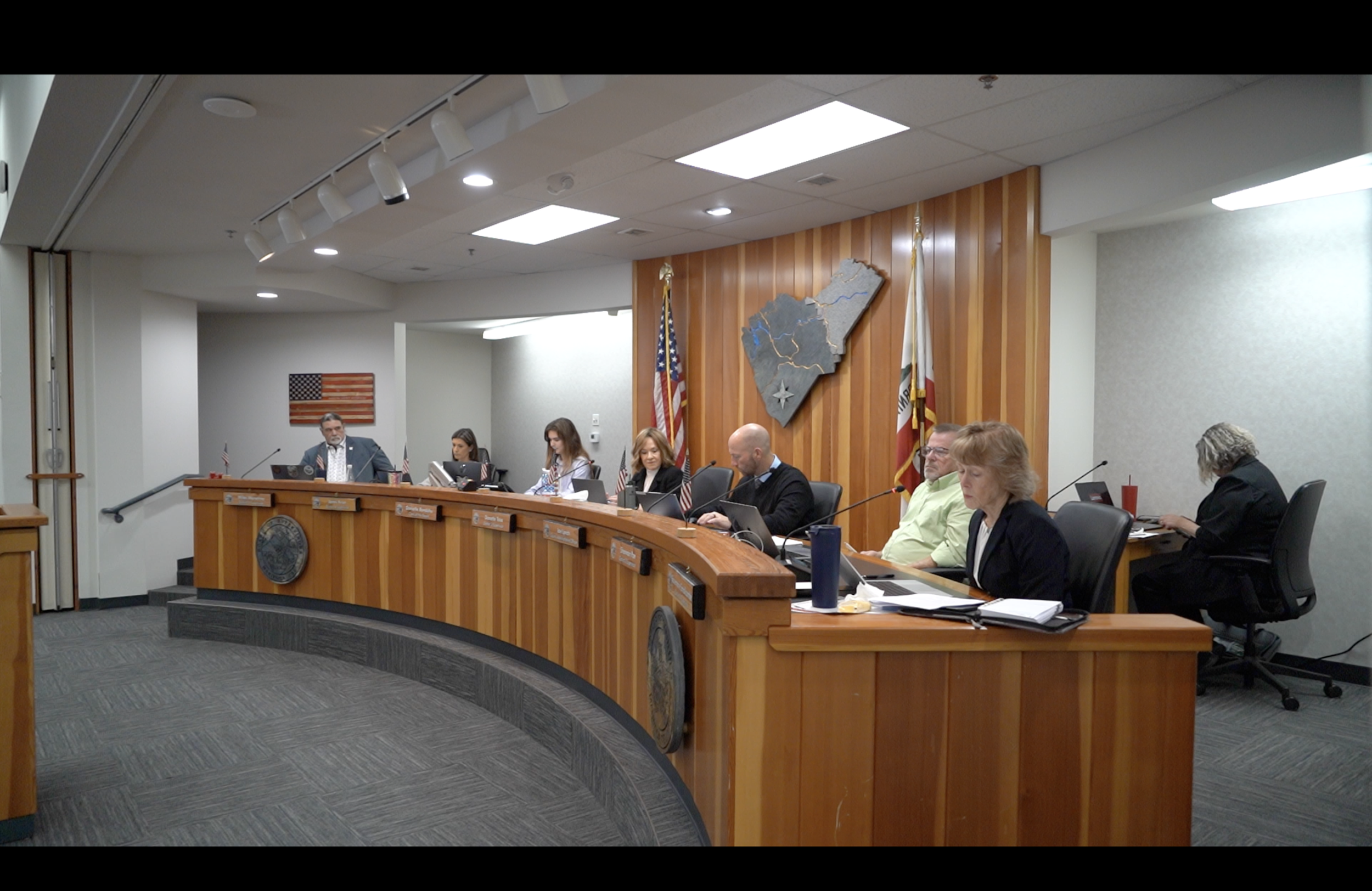
The Mariposa County Board of Supervisors on Nov. 3.
What you need to know about the decisions and discussion from the Nov. 3 meeting of the Mariposa County Board of Supervisors: Budget Roses (& Onions), Citizen Committees Axed, Chamber Keeps Visitor Center, Water Woes Likely Heading to Vote, and Farewell to Farrington
FY26-27 BUDGET: OF ROSES & ONIONS
Assistant County Administrator Leah Westerlund has a way with metaphors, describing the three-month delayed FY26-27 budget as a combination of “roses and onions, mostly roses.”
First, the roses. It is a balanced budget at $97 million. The Transient Occupancy Tax (TOT) brought in $23M, about $1.5M more than the previous year. Other tax revenue and various grants combined to increase revenue by $34 million over previous years.
The county has also reduced county personnel by 10 percent (30 employees), in part through buyouts, that reduced expenses by $6M.
But the roses make the onions stick out. The biggest budget driver is employee salaries and benefits that total $55 million, a 62 percent increase since 2019. The budget for the Health & Human Services Administration will be $43 million this year, a 95 percent increase in the last eight years. In the same breath, it is important to note that HHSA revenue, primarily from state and federal resources, has increased by $34M.
Some like to think of the mushrooming social services bill as “free money.” But as the board has learned repeatedly, it comes with strings, and right sizing personnel after the money runs out is no easy task. And HR 1, the so-called ‘Big Beautiful Bill,’ is coming home to roost at the end of the year, with potentially draconian cuts to social services. That will be the biggest, most putrid onion of all.
Mariposa County also finds itself fiscally anxious over the fickle nature of TOT. Another rockslide along Highway 140 during an El Nino year could spell trouble for TOT.
Speaking of disasters, there was a lengthy discussion about FEMA (Federal Emergency Management Agency) dragging its feet on paying bills from a series of disasters in Mariposa County, including debris removal from the 2022 Oak Fire and winter storms in 2022 and 2023.
As Public Works Director Shannon Hansen describes it, FEMA may pay a small percentage up-front but will begin slow rolling further payments or adding new requirements when the final bill comes in higher.
But as the Tom Petty song goes, “It’s the waiting that’s the hardest part.”
“We are always waiting on FEMA,” Hansen says in frustration. “FEMA is never waiting on us.”
Hanson says there are six or seven projects where FEMA is essentially saying, “Do them and we’ll see if we pay.”
Hansen received an email last week closing out claims on the Detweiler Fire from 2017.
“We submit everything and it takes years to reimburse and it’s just a percentage of what is it is,” she says.
The Free Agent Take: The budget could be worse, but rough seas are ahead.
GOODBYE 10 CITIZEN COMMITTEES
The Mariposa County Board of Supervisors voted 3-2 to eliminate ten citizen advisory committees, arguing variously that the committees had either met infrequently, outlived their objective, or failed to provide tangible work product.
The list includes the Coulterville Planning Advisory Committee, Fish Camp Town Planning Advisory Committee, El Portal Planning Advisory Committee, Greeley Hill Planning Advisory Committee, Yosemite West Planning Advisory Committee, Housing Program Advisory Committee, Mariposa Advisory Task Force, Central Sierra Broadband Utility Zone Consortium, Childcare Task Force, Surface Mining Technical Advisory Committee, and most notably, the Code Compliance Advisory Committee.
Clerk of the Board Danielle Bondshu said there were 55 unfilled vacancies among the various committees and detailed how some of the committees hadn’t met in years. Bondshu said the decision wasn’t an attempt to “hinder voices,” and the advisory committees were neither oversight boards nor watchdogs of government.
Some important footnotes: The mining committee was specifically mandated to deal with surface and placer mining and would not have purview over the three deep rock mining operations – Blue Moon (Hornitos), Lode Gold (Bear Valley), and Mariposa Gold Mines (Mt. Ophir) -- currently in various stages of development.
In a similar vein, the Coulterville Task Force was not advising the county on the problematic water and sewer issues the town is experiencing. (More on that below).
One of the few voices of dissent came from District One Supervisor candidate Lisa Edelheit, who by tomorrow may be supervisor elect. Edelheit argued that “citizen committees are useful and helpful,” and that many of the committees were “unclear about their roles.”
The most high-profile, high-drama and fraught of these advisory boards was the Code Compliance Committee. Staff argued that after five years of meetings the committee had failed to come up with any substantial reforms.
For the uninitiated, code compliance refers generally to issues regarding unpermitted structures, garbage, and potential environmental hazards. The issues are thorny and complex and rub up against local notions of privacy rights. (The shadow of the Jerry Cox case loomed over the committee’s work.)
A sticking point became the cost of abatement and who picks up the tab. The Code Compliance Committee toiled for years in the background, and some might reasonably wonder if it ever had the necessary supervision and guidance from the board. It likely got lost in the metaphorical forest.
Mariposa Development Services Director Greg Thompson has told supervisors he could bring necessary reforms with code compliance to the board within six months.
Supervisors Jenni Kiser and Shannon Poe voted against eliminating all the advisory committees with one vote, preferring to cast individual votes on each committee.
The Free Agent Take: Participatory democracy implies just that, participation. But doing away with ten advisory committees in one swoop is terrible optics and creates the perception that the county supervisors don’t value citizen participation.
MARIPOSA VISITOR CENTER, SAME AS IT EVER WAS
After a bitter and emotionally exhausting fight over what the Mariposa Visitor Center could be/should be, the board settled for the status quo.
The Supervisors gave the $1.3 million contract to operate the Visitor Center to the Chamber of Commerce. It is a five-year contract at an annual expense of $265,000 to $295,000, or about $40,000 more than the previous contract.
Readers of my coverage in the Mariposa Gazette will recall a somewhat tense series of Town Hall meetings and public hearings about the future of the Visitor Center.
It began earlier this year with county staff presenting the case that while the Chamber operates a lovely bricks and mortar Visitor Center at 5158 Highway 140, it had failed to enter the 21st Century world of social media. Critics added that it seemed hopelessly moribund in the analogue at a time when the number of actual visitors to its prime location had dropped significantly.
County staff recommended giving the contract to Juliette Vuillaume of Yosemite Foothills, a social media savvy content creator and marketer from Oakhurst.
That was a wake-up call for the Chamber of Commerce, which quickly marshalled its defenders and packed the various hearings and town halls. An early refrain was why would we give the contract to “an outsider from Madera.”
Two things were decisive as the debate played out over the last year. First, no one can imagine a better place for the Visitor Center besides its current location at the intersections of Highway 49 and 140, along the all-weather route into Yosemite National Park. Much to the dismay of Supervisors Miles Menetrey and Shannon Poe, the Chamber appears to have a lock on the lease for the current spot, and the Chamber isn’t giving it up.
Second, the Yosemite Mariposa County Tourism Bureau didn’t necessarily want the Mariposa Visitor Center in its social media sandbox. The Tourism Bureau, which is funded by a 1.5 percent bed tax, is not directly connected to the Visitors Center. But the Tourism Bureau spends handsomely for social media and feared a new entity might dilute its rather sophisticated sphere of influence.
Outgoing Tourism Bureau Director Jonathan Farrington talked about the possibility of the Visitor Center “diluting the brand.” Farrington, who departs his position later this month, added at the supervisor’s meeting that there is still a role for a Visitor Center for people who don’t use the internet and simply find themselves in town looking for something to do.
A telling moment came at a second town hall, when County Administrative Officer Joe Lynch, who championed metrics, proof of performance, and ROI (Return on Investment) when issuing RFPs, suddenly recognized the two independent roles played by the Tourism Bureau and Visitor Center. “I don’t know what I was thinking,” said Lynch. “Maybe I was having a bad day.”
In the end, the Chamber got the message about social media. The Mariposa Visitor Center has raised its social media game in recent months and is doing a better job at promoting local events. The near-death experience seems to have energized it.
Notably, Vuillaume, who applied for the last to the request for proposals (RFP) for the Visitor Center in 2023 and earned the staff’s recommendation earlier in 2026, did not apply again.
The Free Agent Take: The Chamber showed it still has clout. But it may be a pyrrhic victory. It left a bitter after taste with some young entrepreneurs who do business in Mariposa County.
WATER WOES LIKELY HEADING TO VOTE
While not a specific agenda item, there was tangential discussion of the water and sewer issues plaguing four communities: Coulterville, Lake Don Pedro, Yosemite West, and Mariposa Pines.
County Administrator Joe Lynch said the county will begin the so-called Proposition 218 Process that could end up putting rate increases for those residents to a vote. But before any vote the process requires a cost-of-service and engineering study, a 45-day written notice, a public hearing, and a written protest period. All that before residents would take a vote, which requires 50 percent plus one to pass any rate increase.
But here’s the rub, three of those communities have turned down rate increases before. Only Yosemite West, and its upper income residents, seem like they might approve such an increase. Perhaps not coincidentally, the Prop 218 Process will likely begin with Yosemite West.
The alternative if residents won’t approve a rate increase? After the meeting Lynch offered a few possibilities to the California Free Agent. The most promising, he said, is a kind of “paid internship” in Coulterville for a couple of residents that would allow them to eventually take control of their water system. Meantime, the county continues to seek state funds, but most funding sources want the water and sewer systems to be financially viable, not (pardon the pun) underwater.
There is also the possibility that a private operator could come in, perhaps able to manage one or more of the systems more cost effectively and achieving some economies of scale. The worst-case scenario is receivership, which also could mean a private contractor running the water system, depriving residents of any voice in future rate increases.
The Free Agent Take: This is an existential problem for Coulterville, in particular. The ‘For Sale’ signs on homes in town speak to an exodus already underway. Without a solution, it risks becoming a ghost town.
FAREWELL TO FARRINGTON
“We’ve been through some stuff,” Jonathan Farrington told the Board of Supervisors, in his characteristically understated manner.
As the Yosemite Mariposa County Tourism CEO and Executive Director for the last eight years, he has navigated the bureau through fire, floods, rockslides, and federal government shutdowns.
Farrington is retiring in a few days, Nov. 13. Almost in passing, he mentioned that there are five finalists for his position, and the announcement of his replacement is likely very soon.
Farrington leaves the stage at a critical juncture.
The bureau is financed through a 1.5 percent bed tax known as TBID (Tourism Business Improvement District), which is collected alongside the 12 percent TOT.
That tax was approved by voters in 2018 and comes up for renewal in 2028. That vote will be here before you know it.
There are also strategic challenges ahead. Mariposa County may be losing ground to neighboring counties willing to cut deals to reduce TOT to attract upscale hospitality deals.
Farrington hinted that such deals should be in Mariposa County’s future as well.
“We have an aging hotel and motel stock, that is losing market share,” Farrington told the board. “Average rates are down as well,” he added.
Farrington suggested that a hotel owner operating a two-star motel, could be persuaded to upscale to a three-star or four-star “lifestyle brand,” in exchange for reducing TOT.
It reflects a broader trend: The continued upscaling of the hospitality industry for high-value tourists with plenty of bucks to spend. But those lower end hotels, let’s call them “value propositions,” are where working families can afford to stay when they visit Yosemite.
As an aside, Farrington mentioned that the closure of the historic Wawona Hotel in Yosemite Valley has reduced TOT by $1million. Recently, Yosemite National Park Superintendent Ray McPadden mentioned the possibility that the adjacent building could be reopened while the main hotel building awaits costly repairs.
Farrington has spent 50 years in hospitality and is the former Regional Sales and Marketing for Delaware North when it had the contract for Yosemite National Park.
Farrington has said he plans to take a six-month sabbatical (there’s been talk of fishing), before returning to the hospitality game in a consulting role.
The Free Agent Take: Farrington is a pro and brought an undeniable sophistication to the Tourism Bureau. He could deliver uncomfortable truths in an extraordinarily diplomatic manner. Big shoes to fill.